


Mass dependent and field shift isotope fractionation in platinum group elements
ABSTRACT
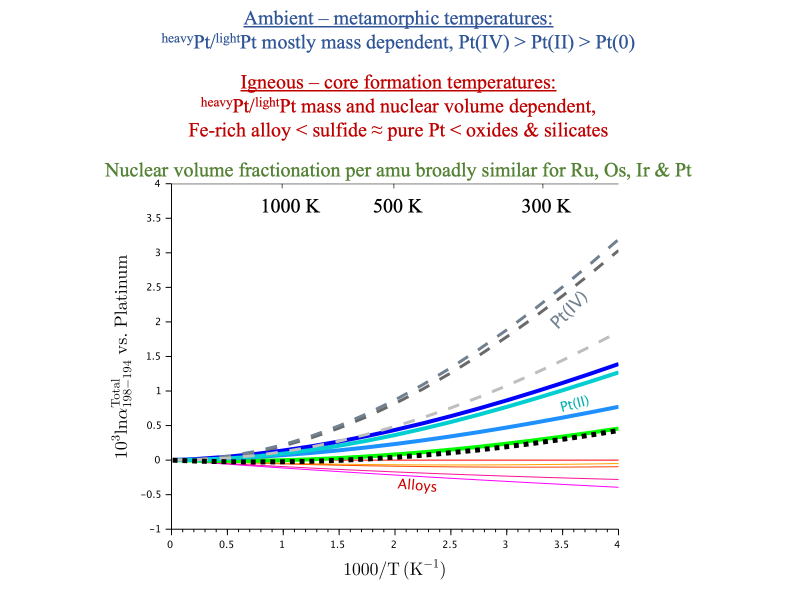
Theoretical estimates of equilibrium platinum-isotope (198Pt/194Pt) fractionation including both the nuclear volume component of the field shift effect and mass dependent fractionation are reported. Field shift (nuclear volume) fractionations in the related elements iridium, osmium, and ruthenium are also reported. For Os, Ir, and Pt, field shift fractionation is predicted to be no more than ~0.1-0.2‰ per amu at geochemically relevant temperatures, with mass-dependent fractionation in Pt-bearing species having a larger range at 25ºC (up to 0.6‰ per amu for PtIV-oxides relative to Pt0 and PtII). However, the mass-dependent component decreases more rapidly at higher temperatures, scaling in proportion to 1/T2 while the field shift component scales as 1/T. Field shift fractionations in the other platinum group elements are qualitatively similar, but typically smaller on a per amu basis. Field shift fractionation for all elements studied show a pattern of isotopes with larger charge volumes (more massive isotopes, for these elements) being most concentrated in species with the smallest positive oxidation states studied (PtII, IrIII, RuIV, and OsIV), and less concentrated in species with higher oxidation states (PtIV, IrIV, RuVI to VIII, and OsVI to VIII). Field shift fractionations of platinum, osmium, and iridium isotopes in metals are dependent on alloy composition, favoring smaller (less massive) isotopes in iron-rich compositions. In contrast, mass dependent fractionation tends to concentrate massive isotopes in species with high oxidation states, and shows little sensitivity to alloy composition. A hypothetical Pt-substituted olivine is predicted to show total equilibrium 198Pt/194Pt fractionation of approximately +0.1‰ relative to the iron-rich alloy Fe7Pt at core-mantle differentiation temperatures near 2000 K, and +0.06‰ near 3000 K. While it is unclear which modeled species (if any) is the best analog for platinum in a silicate melt, Pt-substituted olivine, native platinum, and solid PtS are all capable of producing an isotopically heavy pre-late-veneer mantle. Only a Rayleigh-type Pt-olivine vs. Fe7Pt model is able to approach the previously observed 0.4-0.6‰ fractionation between chondrites and the early Archean mantle.
KEYWORDS
Keywords: Platinum isotopes, nuclear field shift, ruthenium isotopes, osmium isotopes, iridium isotopes- Published : 2026
- Released on J-STAGE : -
- Received : 2025/07/29
- Accepted : 2026/01/18
- DOI : https://doi.org/10.2343/geochemj.GJ26004
- J-STAGE URL : https://www.jstage.jst.go.jp/article/geochemj/advpub/0/advpub_GJ26004/_article/-char/en
- J-Online ISSN: 1880-5973
- Print ISSN : 0016-7002
- ISSN-L : 0016-7002
All Issues
- Vol.60, 2026
- Vol.59, 2025
- Vol.58, 2024
- Vol.57, 2023
- Vol.56, 2022
- Vol.55, 2021
- Vol.54, 2020
- Vol.53, 2019
- Vol.52, 2018
- Vol.51, 2017
- Vol.50, 2016
- Vol.49, 2015
- Vol.48, 2014
- Vol.47, 2013
- Vol.46, 2012
- Vol.45, 2011
- Vol.44, 2010
- Vol.43, 2009
- Vol.42, 2008
- Vol.41, 2007
- Vol.40, 2006
- Vol.39, 2005
- Vol.38, 2004
- Vol.37, 2003
- Vol.36, 2002
- Vol.35, 2001
- Vol.34, 2000
- Vol.33, 1999
- Vol.32, 1998
- Vol.31, 1997
- Vol.30, 1996
- Vol.29, 1995
- Vol.28, 1994
- Vol.27, 1993
- Vol.26, 1992
- Vol.25, 1991
- Vol.24, 1990
- Vol.23, 1989
- Vol.22, 1988
- Vol.21, 1987
- Vol.20, 1986
- Vol.19, 1985-1986
- Vol.18, 1984
- Vol.17, 1983
- Vol.16, 1982
- Vol.15, 1981
- Vol.14, 1980
- Vol.13, 1979
- Vol.12, 1978
- Vol.11, 1977
- Vol.10, 1976
- Vol.9, 1975
- Vol.8, 1974
- Vol.7, 1973
- Vol.6, 1972-1973
- Vol.5, 1971
- Vol.4, 1970-1971
- Vol.3, 1969-1970
- Vol.2, 1968
- Vol.1, 1966-1967