


Neon permeation experiments using a polyimide sheet at low temperatures: towards in situ Martian atmospheric Ne measurements
ABSTRACT
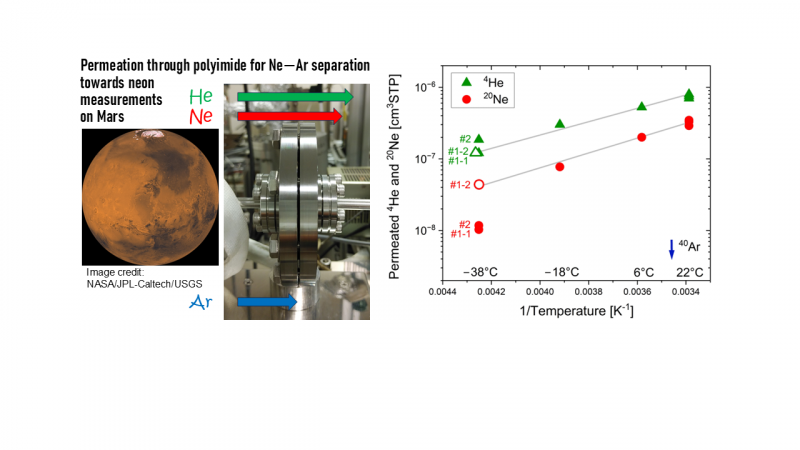
The compositions of planetary atmospheres provide key constraints on the origin and evolution of the planets. Mars has a thin atmosphere dominated by CO2, with Ne detected by the Viking mission, although its abundance and isotopic composition is not well defined. A major technical challenge for in situ Ne measurements on Mars is to separate Ne from Ar before mass spectrometry, because 40Ar2+ interferes with 20Ne+. Previous studies have demonstrated that Ne–Ar separation can be achieved using polyimide membranes. In order to characterize the temperature dependence of permeation relevant to Martian mission, we investigated gas permeation through a 100-µm-thick polyimide sheet at 6 °C, −18 °C, and −38 °C, and measured the permeated He, Ne, and Ar amounts, as well as 20Ne/22Ne ratio. The amounts of permeated He and Ne decrease with decreasing temperature. At −38 °C, the permeated 4He and 20Ne amounts are lower than the room temperature values by factors of ~6 and ~7, respectively. No permeated 40Ar above background level was detected. The 20Ne/22Ne ratios corrected for mass-dependent fractionation agree with the terrestrial atmospheric ratio within analytical uncertainty, except during initial non-steady-state permeation at −38 °C. Temperature dependency of permeated amounts indicates that the permeation fluxes through a 100-µm-thick polyimide at 20 °C give 2.2 × 10⁻¹¹ and 2.7 × 10⁻¹² cm3STP/sec/cm2/Pa for 4He and 20Ne, respectively. Under Martian atmospheric pressure, permeation through a 100-µm-thick polyimide for 40–60 min at temperature between ~10 °C and room temperature provides a Ne amount of 1–2 × 10⁻⁹ cm3STP/100 cm2 with effective Ne-Ar separation.
KEYWORDS
Keywords: Martian atmosphere, noble gas, neon, polyimide, permeation- Published : 2026
- Released on J-STAGE : -
- Received : 2026/01/04
- Accepted : 2026/03/15
- DOI : https://doi.org/10.2343/geochemj.GJ26006
- J-STAGE URL : https://www.jstage.jst.go.jp/article/geochemj/advpub/0/advpub_GJ26006/_article/-char/en
- J-Online ISSN: 1880-5973
- Print ISSN : 0016-7002
- ISSN-L : 0016-7002
All Issues
- Vol.60, 2026
- Vol.59, 2025
- Vol.58, 2024
- Vol.57, 2023
- Vol.56, 2022
- Vol.55, 2021
- Vol.54, 2020
- Vol.53, 2019
- Vol.52, 2018
- Vol.51, 2017
- Vol.50, 2016
- Vol.49, 2015
- Vol.48, 2014
- Vol.47, 2013
- Vol.46, 2012
- Vol.45, 2011
- Vol.44, 2010
- Vol.43, 2009
- Vol.42, 2008
- Vol.41, 2007
- Vol.40, 2006
- Vol.39, 2005
- Vol.38, 2004
- Vol.37, 2003
- Vol.36, 2002
- Vol.35, 2001
- Vol.34, 2000
- Vol.33, 1999
- Vol.32, 1998
- Vol.31, 1997
- Vol.30, 1996
- Vol.29, 1995
- Vol.28, 1994
- Vol.27, 1993
- Vol.26, 1992
- Vol.25, 1991
- Vol.24, 1990
- Vol.23, 1989
- Vol.22, 1988
- Vol.21, 1987
- Vol.20, 1986
- Vol.19, 1985-1986
- Vol.18, 1984
- Vol.17, 1983
- Vol.16, 1982
- Vol.15, 1981
- Vol.14, 1980
- Vol.13, 1979
- Vol.12, 1978
- Vol.11, 1977
- Vol.10, 1976
- Vol.9, 1975
- Vol.8, 1974
- Vol.7, 1973
- Vol.6, 1972-1973
- Vol.5, 1971
- Vol.4, 1970-1971
- Vol.3, 1969-1970
- Vol.2, 1968
- Vol.1, 1966-1967