


Chemical structure analysis of cosmic organic dust analogue using high-temperature vacuum Temperature-Programmed Desorption (TPD)
ABSTRACT
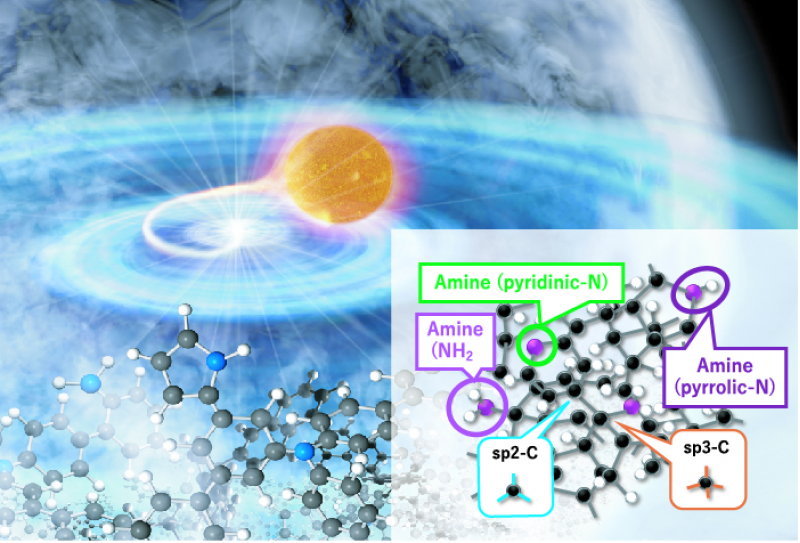
To identify the chemical structure of quenched nitrogen-included carbonaceous composite (QNCC), synthesized as analogues of organic dust formed around novae, we conducted high-temperature vacuum temperature-programmed desorption (TPD) analysis and X-ray photoelectron spectroscopy (XPS) on QNCC and filmy quenched carbonaceous composite (QCC) for comparison. QNCC is a laboratory organic dust synthesized by quenching and condensing plasma generated from hydrocarbon dust, such as polycyclic aromatic hydrocarbons (PAHs) and filmy QCC, and nitrogen gas using a 2.45 GHz microwave source. The infrared spectrum of QNCC closely matches that of the unidentified infrared (UIR) bands observed around classical novae, making QNCC the best laboratory analogue at present for organic dust formed in these circumstellar environments. The analysis revealed that both filmy QCC and QNCC are primarily composed of sp3-bonded carbon (i.e., diamond-like carbon), predominantly with hydrogen-terminated structures and small amounts of alkyl functional groups. The low desorption levels of N2 and relatively high amounts of HCN and NH3 from QNCC indicated in the TPD analysis suggest that QNCC is characterized by minor inclusion of graphitic nitrogen and major inclusion of pyridinic and pyrrolic nitrogen. Additionally, comparison of the desorption profile of HCN in the TPD experiment with temperature for QNCC, nanodiamond, and amine-modified nanodiamond indicates that amine structures attached to sp3 carbon are also present in QNCC.
KEYWORDS
Keywords: (ISM:) dust, extinction, infrared: ISM, astrobiology- Published : 2026
- Released on J-STAGE : -
- Received : 2026/01/05
- Accepted : 2026/04/23
- DOI : https://doi.org/10.2343/geochemj.GJ26014
- J-STAGE URL : https://www.jstage.jst.go.jp/article/geochemj/advpub/0/advpub_GJ26014/_article/-char/en
- J-Online ISSN: 1880-5973
- Print ISSN : 0016-7002
- ISSN-L : 0016-7002
All Issues
- Vol.60, 2026
- Vol.59, 2025
- Vol.58, 2024
- Vol.57, 2023
- Vol.56, 2022
- Vol.55, 2021
- Vol.54, 2020
- Vol.53, 2019
- Vol.52, 2018
- Vol.51, 2017
- Vol.50, 2016
- Vol.49, 2015
- Vol.48, 2014
- Vol.47, 2013
- Vol.46, 2012
- Vol.45, 2011
- Vol.44, 2010
- Vol.43, 2009
- Vol.42, 2008
- Vol.41, 2007
- Vol.40, 2006
- Vol.39, 2005
- Vol.38, 2004
- Vol.37, 2003
- Vol.36, 2002
- Vol.35, 2001
- Vol.34, 2000
- Vol.33, 1999
- Vol.32, 1998
- Vol.31, 1997
- Vol.30, 1996
- Vol.29, 1995
- Vol.28, 1994
- Vol.27, 1993
- Vol.26, 1992
- Vol.25, 1991
- Vol.24, 1990
- Vol.23, 1989
- Vol.22, 1988
- Vol.21, 1987
- Vol.20, 1986
- Vol.19, 1985-1986
- Vol.18, 1984
- Vol.17, 1983
- Vol.16, 1982
- Vol.15, 1981
- Vol.14, 1980
- Vol.13, 1979
- Vol.12, 1978
- Vol.11, 1977
- Vol.10, 1976
- Vol.9, 1975
- Vol.8, 1974
- Vol.7, 1973
- Vol.6, 1972-1973
- Vol.5, 1971
- Vol.4, 1970-1971
- Vol.3, 1969-1970
- Vol.2, 1968
- Vol.1, 1966-1967