


Ethanol released from Ryugu grains transported using the Facility to Facility Transfer Container
ABSTRACT
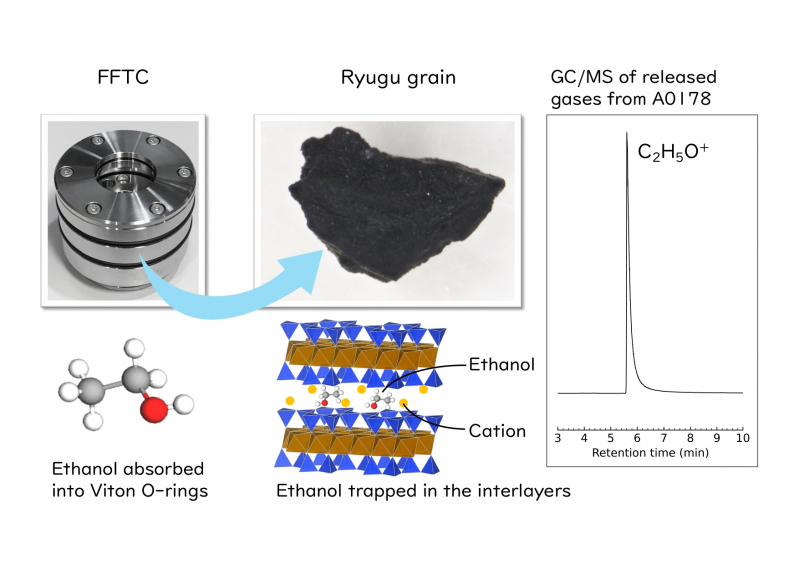
Ryugu samples and carbonaceous chondrites contain organic matter that is expected to record the molecular evolution from the presolar stage to the early Solar System. In contrast to CI chondrites, Ryugu samples are well suited for investigating pristine organic components because they have not undergone terrestrial weathering. In this study, we analyzed volatile organic components released from Ryugu grains by vacuum pyrolysis and gas chromatography/mass spectroscopy (GC/MS). Two of three Ryugu grains released volatile organic fragments at ~80–120°C; however, such releases were not observed in other carbonaceous chondrites. The GC/MS of released gases from another Ryugu grain revealed that the gases were dominated by ethanol, with a concentration of ~100 μmol/g, while other components were scarcely detected. We found that O-rings used to seal a Facility to Facility Transfer Container (FFTC) that had been used for sample transportation contained ethanol absorbed during cleaning. Transportation tests of blank samples revealed that blank samples transported using FFTC released markedly more ethanol than those transported in a container without an O-ring. These results indicate that the O-rings of the FFTC were the contamination source. Ethanol derived from O-rings was likely trapped in the interlayers of phyllosilicates in Ryugu samples and released via heating in vacuum. This contamination could affect the reported bulk abundances and isotopic compositions of carbon and hydrogen in Ryugu samples. Further investigations using intact Ryugu samples are expected to clarify the representative characteristics of Ryugu.
KEYWORDS
Keywords: Ryugu, Facility to Facility Transportation Container (FFTC), ethanol, contamination- Published : 2026
- Released on J-STAGE : 2026/09/15
- Received : 2026/05/15
- Accepted : 2026/07/24
- DOI : https://doi.org/10.2343/geochemj.GJ26018
- J-STAGE URL : https://www.jstage.jst.go.jp/article/geochemj/60/5/60_GJ26018/_article/-char/en
- J-Online ISSN: 1880-5973
- Print ISSN : 0016-7002
- ISSN-L : 0016-7002
All Issues
- Vol.60, 2026
- Vol.59, 2025
- Vol.58, 2024
- Vol.57, 2023
- Vol.56, 2022
- Vol.55, 2021
- Vol.54, 2020
- Vol.53, 2019
- Vol.52, 2018
- Vol.51, 2017
- Vol.50, 2016
- Vol.49, 2015
- Vol.48, 2014
- Vol.47, 2013
- Vol.46, 2012
- Vol.45, 2011
- Vol.44, 2010
- Vol.43, 2009
- Vol.42, 2008
- Vol.41, 2007
- Vol.40, 2006
- Vol.39, 2005
- Vol.38, 2004
- Vol.37, 2003
- Vol.36, 2002
- Vol.35, 2001
- Vol.34, 2000
- Vol.33, 1999
- Vol.32, 1998
- Vol.31, 1997
- Vol.30, 1996
- Vol.29, 1995
- Vol.28, 1994
- Vol.27, 1993
- Vol.26, 1992
- Vol.25, 1991
- Vol.24, 1990
- Vol.23, 1989
- Vol.22, 1988
- Vol.21, 1987
- Vol.20, 1986
- Vol.19, 1985-1986
- Vol.18, 1984
- Vol.17, 1983
- Vol.16, 1982
- Vol.15, 1981
- Vol.14, 1980
- Vol.13, 1979
- Vol.12, 1978
- Vol.11, 1977
- Vol.10, 1976
- Vol.9, 1975
- Vol.8, 1974
- Vol.7, 1973
- Vol.6, 1972-1973
- Vol.5, 1971
- Vol.4, 1970-1971
- Vol.3, 1969-1970
- Vol.2, 1968
- Vol.1, 1966-1967