


Fe Isotope Fractionation during Early Diagenetic Pyrite Formation: Constraints from Reaction-Transport Modeling of the Santa Barbara Basin Sediment
ABSTRACT
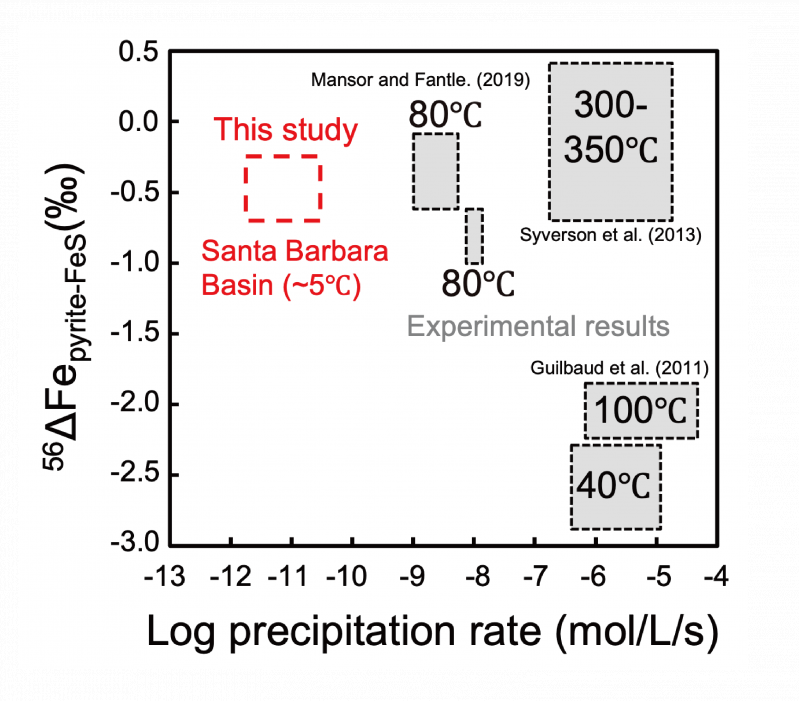
Iron isotope compositions of sedimentary pyrite are widely used to trace redox and biogeochemical processes, but the isotopic fractionation during FeS-to-pyrite conversion in early diagenesis processes remains poorly constrained under natural sedimentary environments. Here we employ a one-dimensional reaction–transport model that explicitly resolves Fe isotope dynamics during early diagenesis in sediments of the anoxic Santa Barbara Basin, a well-studied modern site of active iron–sulfur cycling. The model reproduces the observed pore-water and solid-phase chemical and isotopic depth profiles and constrains the net isotope fractionation associated with FeS-to-pyrite conversion to approximately −0.5‰, irrespective of the Fe isotope fractionation factors of FeS precipitation/dissolution and dissimilatory iron reduction. This small net fractionation may reflect slow pyrite precipitation in the sediment, which may allow positive equilibrium isotope effects to offset the negative kinetic isotope effect associated with pyrite formation. These results would provide a framework for the broader interpretation of iron isotope records in anoxic sediments.
KEYWORDS
Keywords: early diagenesis, Santa Barbara Basin, sediment, pyrite- Published : 2026
- Released on J-STAGE : -
- Received : 2026/08/05
- Accepted : 2026/10/22
- DOI : https://doi.org/10.2343/geochemj.GJ26020
- J-STAGE URL : https://www.jstage.jst.go.jp/article/geochemj/advpub/0/advpub_GJ26020/_article/-char/en
- J-Online ISSN: 1880-5973
- Print ISSN : 0016-7002
- ISSN-L : 0016-7002
All Issues
- Vol.60, 2026
- Vol.59, 2025
- Vol.58, 2024
- Vol.57, 2023
- Vol.56, 2022
- Vol.55, 2021
- Vol.54, 2020
- Vol.53, 2019
- Vol.52, 2018
- Vol.51, 2017
- Vol.50, 2016
- Vol.49, 2015
- Vol.48, 2014
- Vol.47, 2013
- Vol.46, 2012
- Vol.45, 2011
- Vol.44, 2010
- Vol.43, 2009
- Vol.42, 2008
- Vol.41, 2007
- Vol.40, 2006
- Vol.39, 2005
- Vol.38, 2004
- Vol.37, 2003
- Vol.36, 2002
- Vol.35, 2001
- Vol.34, 2000
- Vol.33, 1999
- Vol.32, 1998
- Vol.31, 1997
- Vol.30, 1996
- Vol.29, 1995
- Vol.28, 1994
- Vol.27, 1993
- Vol.26, 1992
- Vol.25, 1991
- Vol.24, 1990
- Vol.23, 1989
- Vol.22, 1988
- Vol.21, 1987
- Vol.20, 1986
- Vol.19, 1985-1986
- Vol.18, 1984
- Vol.17, 1983
- Vol.16, 1982
- Vol.15, 1981
- Vol.14, 1980
- Vol.13, 1979
- Vol.12, 1978
- Vol.11, 1977
- Vol.10, 1976
- Vol.9, 1975
- Vol.8, 1974
- Vol.7, 1973
- Vol.6, 1972-1973
- Vol.5, 1971
- Vol.4, 1970-1971
- Vol.3, 1969-1970
- Vol.2, 1968
- Vol.1, 1966-1967