


Published for geochemistry community from Geochemical Society of Japan.
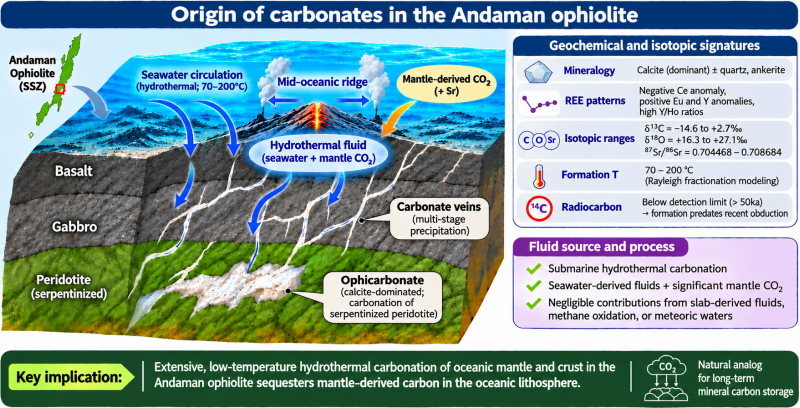
Origin of carbonates in the Andaman ophiolite: C-O-Sr isotopic Constraints
Geochemical Journal, Early Release (Accepted: 2026/10/30)
ABSTRACT
KEYWORDS
Ophicarbonate, hydrothermal carbonation, carbon sequestration, Andaman ophiolite, C-O-Sr isotopes- Published : 2026
- Released on J-STAGE : 2026/11/11
- Received : 2026/03/23
- Accepted : 2026/10/30
- DOI : https://doi.org/10.2343/geochemj.GJ26022
- J-STAGE URL : https://www.jstage.jst.go.jp/article/geochemj/advpub/0/advpub_GJ26022/_article/-char/en
- J-Online ISSN: 1880-5973
- Print ISSN : 0016-7002
- ISSN-L : 0016-7002
All Issues
- Vol.60, 2026
- Vol.59, 2025
- Vol.58, 2024
- Vol.57, 2023
- Vol.56, 2022
- Vol.55, 2021
- Vol.54, 2020
- Vol.53, 2019
- Vol.52, 2018
- Vol.51, 2017
- Vol.50, 2016
- Vol.49, 2015
- Vol.48, 2014
- Vol.47, 2013
- Vol.46, 2012
- Vol.45, 2011
- Vol.44, 2010
- Vol.43, 2009
- Vol.42, 2008
- Vol.41, 2007
- Vol.40, 2006
- Vol.39, 2005
- Vol.38, 2004
- Vol.37, 2003
- Vol.36, 2002
- Vol.35, 2001
- Vol.34, 2000
- Vol.33, 1999
- Vol.32, 1998
- Vol.31, 1997
- Vol.30, 1996
- Vol.29, 1995
- Vol.28, 1994
- Vol.27, 1993
- Vol.26, 1992
- Vol.25, 1991
- Vol.24, 1990
- Vol.23, 1989
- Vol.22, 1988
- Vol.21, 1987
- Vol.20, 1986
- Vol.19, 1985-1986
- Vol.18, 1984
- Vol.17, 1983
- Vol.16, 1982
- Vol.15, 1981
- Vol.14, 1980
- Vol.13, 1979
- Vol.12, 1978
- Vol.11, 1977
- Vol.10, 1976
- Vol.9, 1975
- Vol.8, 1974
- Vol.7, 1973
- Vol.6, 1972-1973
- Vol.5, 1971
- Vol.4, 1970-1971
- Vol.3, 1969-1970
- Vol.2, 1968
- Vol.1, 1966-1967
Current Issue:
Stats:
Impact Factor: 1.6 (2024)
Submission to final decision: 9.6 weeks (2022)